
Sample-Dependent Controls
The sample-dependent controls can be used to evaluate performance across samples. These control oligos are designed for bisulfite-converted human genomic DNA sequences. Because target sequences do not contain CpG dinucleotides, the performance of the control oligos does not depend on the methylation status of the template DNA.
The following controls are sample-dependent:
| • | Bisulfite conversion I |
| • | Bisulfite conversion II |
| • | Specificity I |
| • | Specificity II |
| • | Nonpolymorphic (NP) |
| • | Negative |
Several key steps in the Infinium HTS Methylation Assay require evaluation of both the red and green color channels. For these instances, both red and green channel controls are included.
 Bisulfite Conversion Controls
These controls assess the efficiency of bisulfite conversion of the genomic DNA. The Infinium Methylation probes query a [C/T] polymorphism created by bisulfite conversion of non-CpG cytosines in the genome.
Bisulfite Conversion I
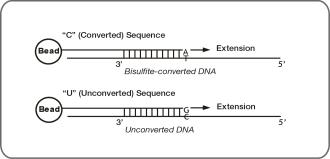
These controls use the Infinium I probe design and allele-specific single base extension to monitor efficiency of bisulfite conversion. If the bisulfite conversion reaction was successful, the C (converted) probes match the converted sequence and are extended. If the sample has unconverted DNA, the U (unconverted) probes are extended. There are no underlying C bases in the primer landing sites, except for the query site itself. Performance of bisulfite conversion controls C1, C2, and C3 should be monitored in the green channel. Controls C4, C5, and C6 should be monitored in red channel.
Bisulfite Conversion II
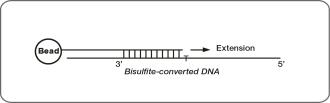
These controls use Infinium II probe design and single base extension to monitor the efficiency of bisulfite conversion. If the bisulfite conversion reaction was successful, the A base is incorporated and the probe has intensity in the red channel. If the sample has unconverted DNA, the G base is incorporated across the unconverted cytosine, and the probe has elevated signal in the green channel.
Specificity Controls
These controls are designed to monitor potential nonspecific primer extension for Infinium I and Infinium II assay probes. Specificity controls are designed against nonpolymorphic T sites.
Specificity I
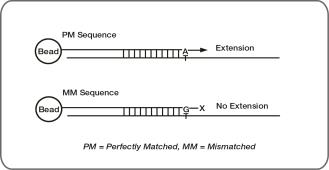
These controls are designed to monitor allele-specific extension for Infinium I probes. The methylation status of a particular cytosine is carried out following bisulfite treatment of DNA by using query probes for unmethylated and methylated state of each CpG locus. In assay oligo design, the A/T match corresponds to the unmethylated status of the interrogated C, and the G/C match corresponds to the methylated status of C. G/T mismatch controls check for nonspecific detection of methylation signal over unmethylated background. PM controls correspond to A/T perfect match and should give high signal. MM controls correspond to G/T mismatch and should give low signal. Performance of GT mismatch controls should be monitored in both green and red channels. The Controls dashboard table lists expected outcome for controls probes.
Specificity II
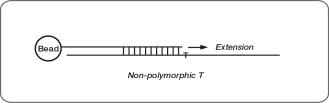
These controls are designed to monitor extension specificity for Infinium II probes and check for potential nonspecific detection of methylation signal over unmethylated background. Specificity II probes should incorporate the A base across the nonpolymorphic T and have intensity in the red channel. If there is nonspecific incorporation of the G base, the probe has elevated signal in the green channel.
Nonpolymorphic Controls
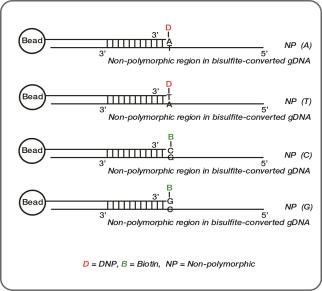
Nonpolymorphic controls test the overall performance of the assay, from amplification to detection, by querying a particular base in a nonpolymorphic region of the bisulfite genome. These controls compare assay performance across different samples. One nonpolymorphic control has been designed to query each of the four nucleotides (A,T, C, and G). The target with the C base results from querying the opposite whole genome amplified strand generated from the converted strand.
Negative Controls
Negative control probes are randomly permutated sequences that should not hybridize to the DNA template. Negative controls are important for methylation studies because of a decrease in sequence complexity after bisulfite treatment. The mean signal of these probes defines the system background. It is a comprehensive measurement of background, including signal resulting from cross-hybridization and nonspecific extension and imaging system background. The GS platform uses the average signal and standard deviation of 600 negative controls to establish detection limits for the methylation probes. Performance of negative controls should be monitored in both green and red channels.
